


Prenatal: Care & Management
- Dec 11, 2018
- 5 min read

Many questions come into our mind when we start planning to exercise during pregnancy. Physical exercises are very important to improve physical fitness and to help prepare your body for labour at the time of delivery.
Are exercises in pregnancy safe? Surprisingly, yes! All you need to know are your limitations during exercise. Pregnancy is not the time to exercise for weight loss, it is the time to exercise for normal vaginal delivery and to prevent miscarriages. Always consult your doctor or therapist before starting any exercise.
You don’t need to exercise all the time. 2-3 times a week for a minimum of 30 minutes is enough to keep your body active and for a healthy circulation. There is no thumb rule about the time you should exercise. Utilising any free time in 24 hrs for exercising is the key to a fit pregnancy. The 30 minutes can be used in stretches, increasing strength and mobility.
Key benefits of prenatal exercises are…
Decreased backache
Normal and healthy delivery
Improved or correct posture
Increased strength, endurance
Toned muscles
Easier path for rebuilding yourself after delivery
Precautions while exercising-
Avoid exercises that increases the abdominal pressure or cause abdominal trauma
Avoid jerky movements
Avoid rapid change in direction
Avoid jumping, skipping and bouncing
Avoid Waist twisting in erect position
Don’t exercise till you get exhausted
Getting up from floor or sitting down should be gradual.
1nd Trimester
Pelvic tilts
Forward and backward

Lie on your back on the floor with your knees bent.
Tighten your abdominal muscles to flatten your back
on the floor. Now move your pelvis up and hold for 10
seconds and then slowly take it down. Repeat this 10
times.
Sideways-

Lie on your back on the floor with knees
bent. Tighten your abdominal muscles to
flatten your back on the floor. Now move your pelvis side ways (left and right).
Kegel’s pelvic floor strengthening exercises-
Lie down your back with knees bent, tighten your pelvic floor muscles, hold the contraction for 10 seconds. Kegel's exercises can be done while sitting, standing, or walking. (Do not forget to keep your spine in neutral position and keep breathing). These exercises will help you to increase bladder control, improve pelvic floor strength and sexual function.
Squatting-
It is an important exercise. It help to

open your pelvic outlet to help the
baby descend. Practice squatting,
it is an excellent exercise to maintain
the range of motion of the hips and to
maintain lower body strength. It also
helps to maintain the core strength. If
not comfortable with normal squats
then you can start with wall squats.
Stretches –
Biceps – grab your hands behind your back with palm together and stretch backward till you feel the stretch in biceps. (for more stretch rotate your arm so your palms face downwards. Hold this stretch for 20-30 seconds.
Triceps- raise your right arm and reach toward your upper back. Pull your right elbow with your left hand. Hold for 20-30 seconds.
Forearms- stand against the wall and place your hands on the wall, fingers pointing downwards.
Neck-
Forward and backward rotation- Stand or sit comfortably, Gently tilt the head to the forward, creating a stretch in the back of the neck. Gently tilt the head
back, creating a stretch in the front of the neck. You may use your hand to assist in pulling your head forward or backwards
2. Side rotations- Stand or sit comfortably, gently rotate your neck in one direction (chin toward shoulder) You may use your hand to assist in pulling.
3. Side tilt (right-left or left- right)-
Stand or sit comfortably, gently bend neck on one side (ear toward shoulder) You may use your hand to assist in pulling
* all stretches hold 10-15 seconds*
Shoulder-
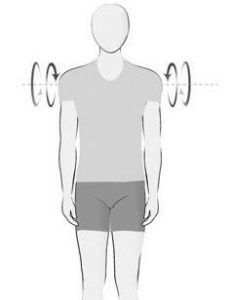
Shoulder rotation (internal and external rotation)- hold hand in horizontal at shoulder level and rotate in upward direction to external rotation and downward for internal rotation.
Shoulder rolling- stand or sit, shrug shoulder upward and
roll backward-downward in circular direction.
Shoulder cross arm stretch - In standing position, Take your left arm across your chest with
the right hand grasp the back part of the left upper arm (just above the elbow) using your right arm, slightly pull the left arm across the body keep the left elbow bent as you pull across the body hold the stretch for 30 seconds.
Straight wall stretching – place both your hands on a wall to
form 90-degree angle between the arms and the body. Now bend from the waist (hip will go backward and chest forward down). keep your scapula set back.
Single arm circle- hold arms outstretched at shoulder level in 90
degree and rotate in clockwise and then anticlockwise direction.
Scapular stretching-

protraction and retraction of scapulae (do not shrug your shoulder while doing this movement) A. Neutral
B. retraction (Abduction)
C. Protraction (Adduction)
Spinal stretch- (thoracic and lumbar)
Quadriceps – stand straight, bend your right knee and reach backward

towards glutes, hold your right ankle with your left hand and pull backwards and in an upward direction to get the stretch on quadriceps. Hold for 20-30 seconds and repeat 3 times.

Hamstrings-
Stand straight with your left foot a few inches in front of your right foot. Bend
your right knee slightly. Lean forward from your hips, and rest both palms on top of your right thigh for balance and support. lean more till you will get maximum stretch.

Glutes-
In supine position (face up/on your back) cross your right knee over
your left knee. take both knees toward your chest, for more stretch you can hold your ankles and pull towards your chest. Make sure you keep your head down. hold for 20-30 seconds and repeat for 3 times.

Groin – in a wide squat position, keep your feet pointing outwards,
now squat and pump 2-3 times to get the groin stretch. Hold for 10 seconds. Do it 3 times

Adductor wall stretch -
Hip rotation- (internal and external stretch)- in prone ( face down) bend your knees to 90 degree and move toward inward and outward direction.
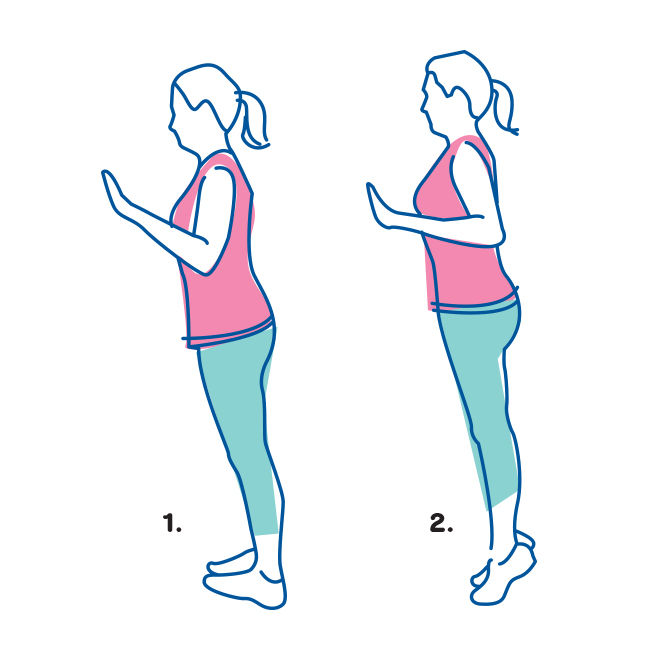
Ankle- in standing position do heel up and toe up movement.
1. on heel (toe up)
2. on toes (heel up)
Strengthening-
Strengthening exercises are going to help you with improving overall health and will increase your bone, tendon and muscle strength, along with improved joint friction.
Strengthening exercises like, biceps curls, shoulder raises, triceps dips, wall push-up, bend row, lats pull down, squats, mini lunges, wall squats, ankle raise & revers etc.
2nd Trimester
** CONTINUE WITH 1st TRIMESTER EXERCISE PROTOCOL IN COMFORT ZONE
3rd Trimester
Pelvic tilt (sitting on a chair)
Sit on a chair with hip and knees in 90-90 degree with straight back and keeping neck in neutral position (keep both hands on waist to direct pelvis) on now move your pelvis in forward and backward direction and then in sideway direction.
Supported squats / Progressive squatting
( with the help of a chair, or a wall)
Cat and camel ( lying or sitting)
Get onto your hands and knees, with your knees apart at hip-

width and your hands also apart at your shoulders level.Tighten your abdominal muscles and arch your spine upward toward the ceiling. Hold the position for at least 10 seconds, then slowly relax your back. Allow your stomach to fall toward the floor, bring your scapula together and stretch your back downwards into a swayback position. Hold for 10 seconds, then return to the starting position.
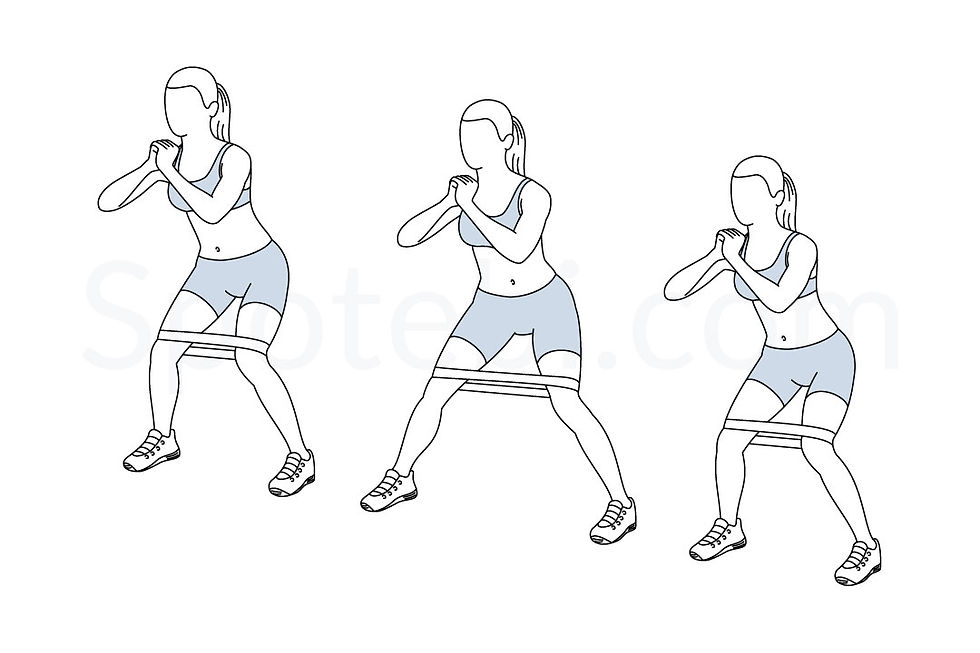
Crab walk/ side walk- In standing position, foot straight parallel to each other, mini squat
with hand on waist and walk sideways.
Progressive butterfly- The importance of doing butterfly exercises when you are pregnant is that they help to strengthen your pelvic floor muscles. It helps to stretch your inner thighs muscles and groin and helps to open up your hips, which will help you during delivery.
** CONTINUE WITH THE 1st TRIMESTER STRETCHES.
Comments